
The contemporary dance world is at a crossroads, grappling with globalism, hyper-interconnectedness, and informational access in a way that may be pushing the art form toward the obscure, the uncertain, the vague, the unknowable—as evidenced in the evening of dance last weekend at the Kirk Douglas Theater in Culver City, presented by ate9 and Jacob Jonas The Company.
The venue was new to me and showed itself to be an excellent space for dance performance, with an intimate house, beautifully raked seating, and technical flexibility. It had been a while since I last reviewed the works of either Danielle Agami or Jacob Jonas, so I was excited to see their latest creations and have the opportunity to write about them.
As a shared bill, the two works could not have been more different. The short list of shared attributes includes the use of small casts, outrageous physicality, and live music performance. The aesthetic and artistic directions of the two companies proved strikingly different and cannot help but be illuminated through stark contrasts. I will do my best to honor them separately before making a few comparisons at the end.
Agami created Soon After in collaboration with the cast, comprised of former Batsheva dancers Billy Barry, Omri Drumlevich, Gianni Notarnicola, and Agami herself. The roughly 30-minute work included original musical composition created and performed by New York–based composer Yuka Honda. The quartet of quirky characters opened the show as the audience members took their seats. The dancers maneuvered around and through the various urban artifacts dressing the stage space, including lamps, aluminum benches, trunks, mirrors, a hammock, a small chalkboard, and rolling shelving units. The mundane interactions in this mix of home and industrial items seemed both happenstance and deeply engaging. The individuals silently existed within this found world, regarding each other in neutral-to-curious exchanges. The most memorable of which was perhaps the iron handcuffs worn by Agami, which were removed by Drumlevich before the start of the performance.
The rest of the stage mirrored the neutral color palette in the costumes. Black, white, tan and metal dominated the space warmed by the practical incandescent work lights and a generally warm lighting palette by Production Manager and Lighting Designer William Adashek. Punches of color, red, orange, plum in the costume and props added visual depth. The theme of visibility and that which is hidden or obscured was balanced by the unconventional inclusion of the large mirror in the upstage-left corner as well as the invitation a handful of audience members received to relocate into chairs set on the side of the performance space. The exposed brick wall and the lack of masking curtains continued to add to the urban, if not industrial, design. There is too much to be described in the myriad details of the space and its design. The impression, however, was one of nuance, variety, and endless possibility, which was then adeptly reflected in the movement vocabulary of the work.

The dancers were simply unparalleled in their performance. Each, with their extensive Gaga training, was an absolute delight to watch, as there was no perceivable edge to their capacity in either physical or emotional expression. The way the dancers inhabited their unique personas allowed for great variety in movement vocabulary, tone, and attitude within the unified work. The ensemble cast felt well-balanced, with each performer having moments in which we got to know their lived experience through subtle shifts of the torso and breath as well as bold expressions of strength and control seen in balances, extensions, and inversions. Athletic duet partnering between Drumlevich and Notarnicola contrasted wild, exuberant play between Barry and Notarnicola, and then later a sensual—if mysterious and uncertain—melting of bodies between Drumlevich and Agami.
The compelling facility of the movers allowed for expert metamorphosis before our eyes—from tormented to silly to sexy to unimpressed. Extreme moments of pedestrianism contrasted with outrageous flashes of rebounding splits and vibratory thrusts. The personalized performance made space for one of the greatest varieties in movement vocabulary I have seen in a single evening-length work. It was truly wild at times, with the four bodies invested non-sequitur states of being, which made it impossible to track yet delightful to witness.
The select use of unison movement (often in pairs and never by all four bodies at the same time) reminded the audience of the ability of the dancers, each so different, to map into exquisite precision not only of gestural and postural design but also timing, intention, breath, and muscle tone. Something about the treatment of the dancers’ anatomy in Agami’s work dissipates United States norms of the body’s preciousness, making the bare breast or exposed nipple not of particular interest. The bodies swing between asexual entities and near-erotic without ever feeling particularly exhibitionist. The resilience and the transformative qualities of the movers allow the human experience of these individuals to be as fluid as any momentary condition.
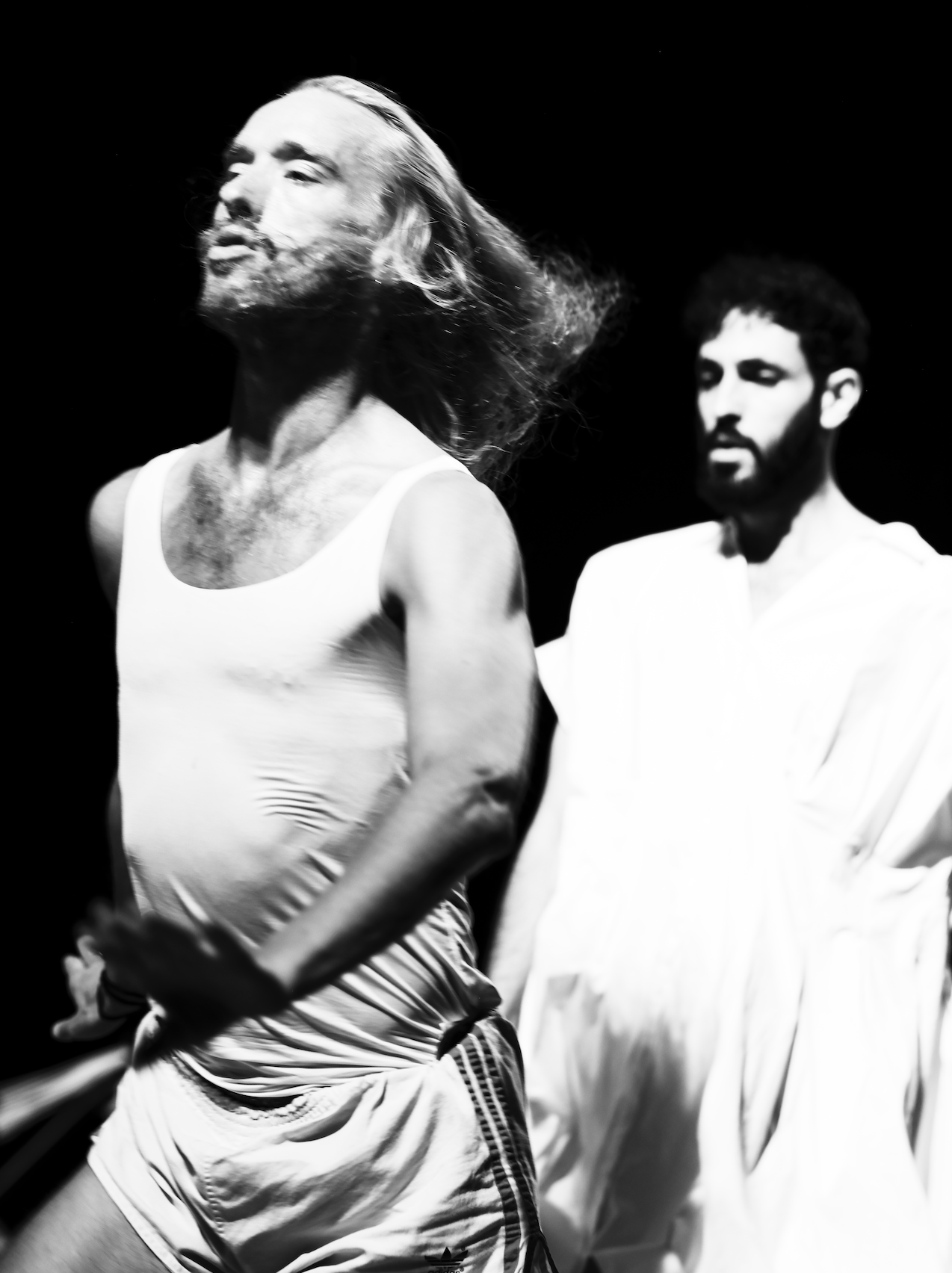
Honda’s electronic score was at times spacious and environmental but also shifted into driving dance beats with samples of Middle Eastern–sounding drums as well as stringed and wind instruments. The groove prompted the cast to surrender to impulses of club gyrations mixed with folk dance footwork that could only make sense in Agami’s wild world of creative unpredictability. Soon After made sense as conceptual partner to Joy, which I had previously experienced in 2021. There is a sort of stream of consciousness that I now associate with Agami’s work, which she crafts with absolute conviction. But this stream of free association is of the body rather than the mind. Each moment seems self-evident, as the movement is spontaneously born of the tissues of the body. It is not to be trapped in a narrative so much as unleashed in a swirl of being-states where we find ourselves swimming in the unforeseen: a duet in a hammock, a head buried in a handbag, a costume change on stage, and then the raucous joy of bouncing and rebounding ecstatically off inflatable pool toys (one of which was a hot dog…naturally).
The world of Soon After is not to be understood but to be felt, and the craft of the performers immersing themselves so fully into the intentionally obscure is what holds it together. The unfolding of the world and the movements of the bodies within the environment perpetuate the work into existence. All aspects of the production—including the ebb and flow in musical shifts, the extensive stage dressing, and the subtle warming and cooling of the lights—reinforced the humanity of these individuals. At the end we knew no more of their circumstances, but we felt their humanity in what Agami identified in the program note as “our neverending journeys.” The piece concluded as unpredictably as it began, leaving the audience in a state of expectation as Agami sat straddled on the floor, uncomfortably pregnant with Notarnicola, who moments before had crawled headfirst into her pelvis and up into her oversized orange dress. Lights out.
Part II of the program shifted the tone of the evening dramatically from the gritty and cluttered to the minimally modern. Haze filled the theater so thick it was difficult to see the back wall. A large illuminated orb some 10 feet in diameter hung off the second electric. A poet, Nathan Birnbaum, dressed in black took the stage, remarking on the importance of breath before evoking images of the sea and bodies hoisting themselves and each other upward. In his poem he named the muses from Greek mythology and set the tone for a Neo-Classical experience stripped of adornments.
Ambient music performed live by Life Footage (Topu Lyo and Mike Thies) filled the space as a distant foghorn sounded. Then smack. Smack smack. SMACK. Two bodies emerged within the fog, slamming their bodies onto the floor with loud cracks, hands and feet repeatedly slamming as the bodies rolled over shoulders and hips to splatter onto the grey marley dance floor. Arching up through backbends only to careen forward onto their knees in thrusting waves and torsos. Lifting up through the pelvis over and over again. Rolling over each other. Neutral countenances but bodies slamming down again and again. Grasping each other’s faces before yanking and pushing each other back down. Smack. Thrusting upward. Tossing around. Smack. Dragging. Dripping. Flopping. Falling backward directly into the bum before—smack—the whole torso and arms flung back to the floor. Waves upon waves of roiling action, and the fog ever so slowly started to dissipate. This opening of Jonas’s Grip, performed by Alexa Donnelly and Paulina Donnelly, was impactful physically and sensorial, to say the least.
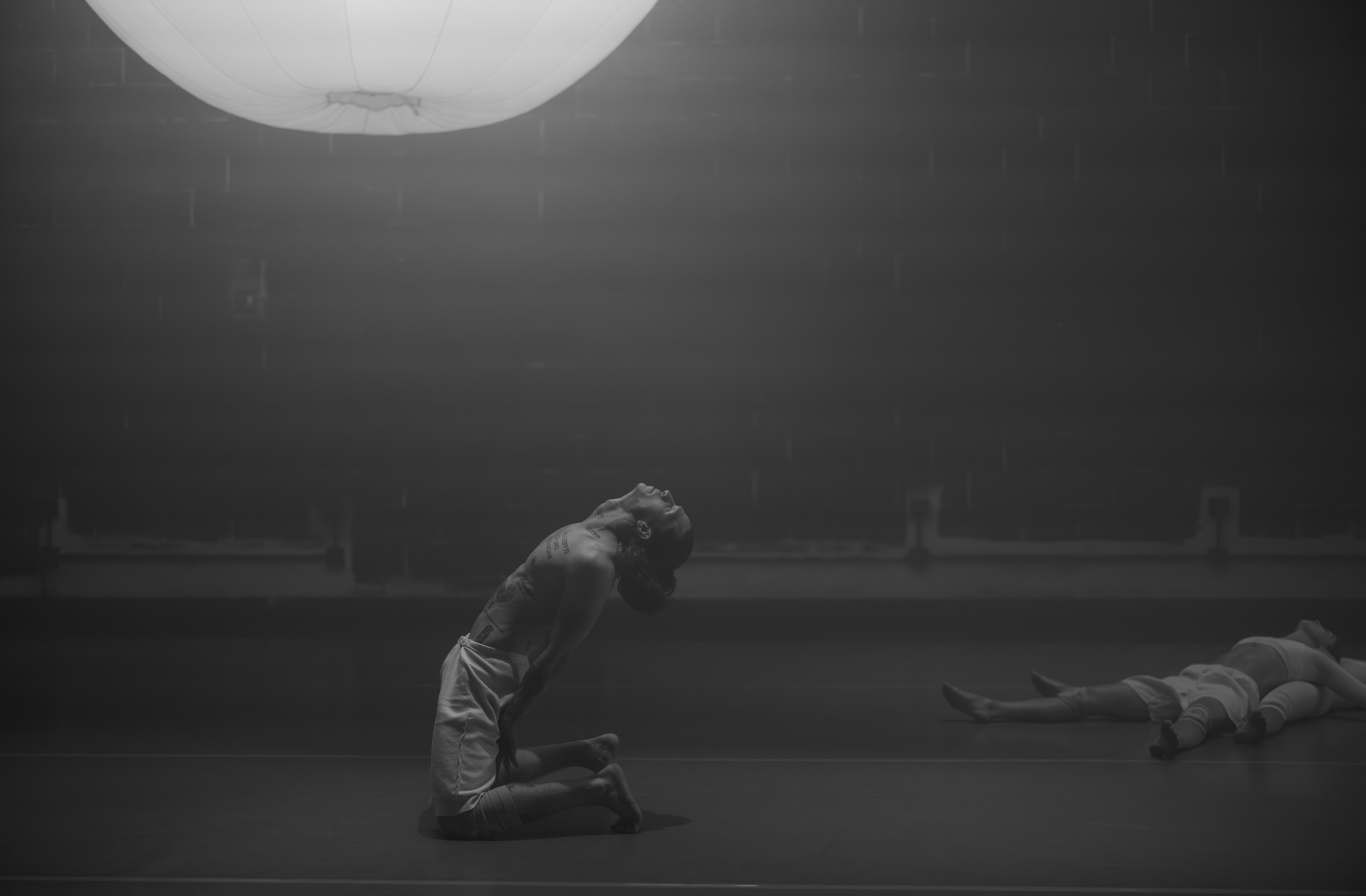
Photo by Joshua Geyer.
The remainder of the work followed suit. Impressive inversions followed by cascading bodies against the floor. Smack. A young man (Jarrett Yeary) seated in the corner on a white plastic garden chair watched the twin dancers. Next to him was a small table with a bouquet of fake white roses and a fluorescent-lighted fish tank with a handful of goldfish swimming about. The watching was steady, perhaps even voyeuristic with a neutral expression and no reactions. The relationship between the three individuals was unclear– and thus a little uneasy in nature. Were they the muses? Were they Greek gods?
Yeary then took the stage, stunning the audience with his gymnastic athleticism, showcasing his own take on the aggressive impact work while punctuating it with multiple variations of one-armed backbends and gasp-inducing front tucks. From this point, new duets formed while the third dancer looked on and caught their breath. More and more of the impact work. Theme and variation exhausted through the repetitions of these hard falls. And, they were what dance theory defines as true falls (where the center of gravity moves beyond the base of support) and not dance falls, in which the center of gravity is safely lowered, giving the illusion of a fall or collapse while the dancer remains in control at all times.

Light knee pads helped ease the crashes to the knees, but still the audience quickly started head-shaking at the impact. It was relentless. When the dancers weren’t smacking themselves against the floor, they grasped and pushed each other in fits of fury before collapsing onto each other to catch their breath for another round.
The distress and aggression stayed constant throughout the piece, with only brief moments of respite in the form of exhausted resignation. The various duets and solos were all flavored with a similar energy rooted in the motif of falling with impact to the floor, then being pulled or thrust upward by another body. Somehow a desperate kiss was introduced before the same pushing and smacking falls continued. The high risk athleticism was nothing like I have ever seen before in a dance show, with the exception of perhaps Diavolo or in my early memories of Stephanie Gilliland. This sort of high-impact work was in some ways more akin to martial arts, parkour, or even WWF than dance at times. These performers were good at taking a hit, that was for sure.
The steady pacing of the work—hit after hit—was unfortunately a weak point in the compositional structure of the evening-length work. The waves of bodies falling just kept coming, and after seeing the performers repeat the same incredible feats time and time again, it started to lose impact. No pun intended.
The ambient music was a stark contrast to the physical aggression and confrontational attitudes emitted from the dancers. The cello and electronic design evoked a forlorn and dystopian quality to the work. Never driving or rhythmic, it was always sensitive and pleading in stark contrast to the desperate, high-intensity movement. The musicians seemed highly attentive to the movement and the textures of their supporting ambience, but with no strong melodic line or metric groove the dance found itself somewhat unanchored.

Photo by Joshua Geyer.
The simple white costumes by Tessa Matthias reinforced a sense of dystopian distress, as the shoulderless female costumes evoked a condition of being worn out. The unique styling of the women allowed the identical twin performers to be easily distinguished, for which I was grateful, and the covered arms allowed for easier sliding against the marley floor. The bare-torsoed Yeary, wearing white sport shorts, seemed to manage the floorwork just fine, and perhaps it helped him in his many torso inversions and shoulder stands. The neutrality of the design reflected the minimalist value in the work and allowed much space for interpretation in terms of who these three individuals were or who they were to each other. While the imagery was mythic, the repeated sound of skin slapping the floor was all too human—were these beings invincible?
While no one could watch this work and be unimpressed by the dancers, I would be remiss if I did not express a degree of concern for the sustainability of their performance. These young dancers may be feeling the after effects of this performance for years to come. I hope I am wrong, but as a longtime bodyworker and dance professional, I do wonder what unforeseen costs there may be down the line. I have no doubt that these dancers have trained in such a way to build their bone density and tissue resilience. There is technique to it. For instance, the sound of the hands slapping on the ground can be cultivated and amplified with practice. I imagine these individuals have received elite training for years in both dance and high-impact practices like either gymnastics or parkour. The impact, while concerning, was actually secondary to the potential for whiplash inherent in the countless flinging backbends. It will be interesting to see the degree of sustainability this work has for the young dancers.
The whole of the piece was dominated by a discomfort in watching the struggling young bodies grapple with each other for an unknown reason– was it a dysfunctional love triangle? The ending, in which they curled up together in a shared repose of sleep, was unsettling, as it reinforced the more subtle glimpses of heterosexual male fantasy I noticed earlier in the work. While there was extensive theme in variation in the movement, the lack of character development left the ending unresolved. The strife was evident; the relentlessness of effort and taking a hit was without question. But, the ultimate meaning behind the work was left in a fog for me.

Thus, perhaps FOG was the precise title for such an evening that seemed to pose more questions than answers. Both artists approached the unknowable through contrasting compositional, movement vocabulary, and aesthetic values. Each work had a remarkable degree of athleticism, strength, and control. Jonas dove headfirst into the use of firm weight, while Agami and her dancers played more with a range of strong and light force. The dancers in Grip modeled profound impact work that felt hard and attacking, with a unilateral sense of urgency and desperation, while the performers in Soon After played more with combinations of suppleness and dynamic resilience, changing their performative sensibilities in a fraction of a moment from flirtatious to serious to comic.
The abstract minimalist design of Jonas resulted in an otherworldly environment that contrasted with the very practical landscape of Agami’s urban dwelling. Both pieces left much to the imagination in terms of narrative content. Overall, the evening was a fascinating and thought-provoking one—undoubtedly one that spurred the audience into many conversations about the extreme aesthetic range within contemporary dance trends and how drastically different the art of the human form can be.
The inclusion of live music is always one I celebrate and thoroughly applaud; being able to witness the musicians recreating their sonic worlds through electronic sampling as well as live instruments is always fascinating. The sound for the live musicians was quite good, despite one overlook-able buzz. And the lighting was elegantly designed, favoring a neutral palette throughout the evening to support the works.
The sold-out theater goes to show that dance is beloved in the Los Angeles community and the audience is willing to support dance artists taking risks in meaningful ways. The proximity of the audience to the stage and the shape and size of the stage are perfect for dance theater, and I look forward to seeing more dance in this space.

Photo by Jobel Medina


 LA Dance Review
I did not see this show, but I am impressed by this review: descriptive, thoughtful, thorough, and filled with questions for the reader to ponder. A review like this is a gift to the reviewed artists; I hope they see it this way.