Photo by Taso Papadakis.
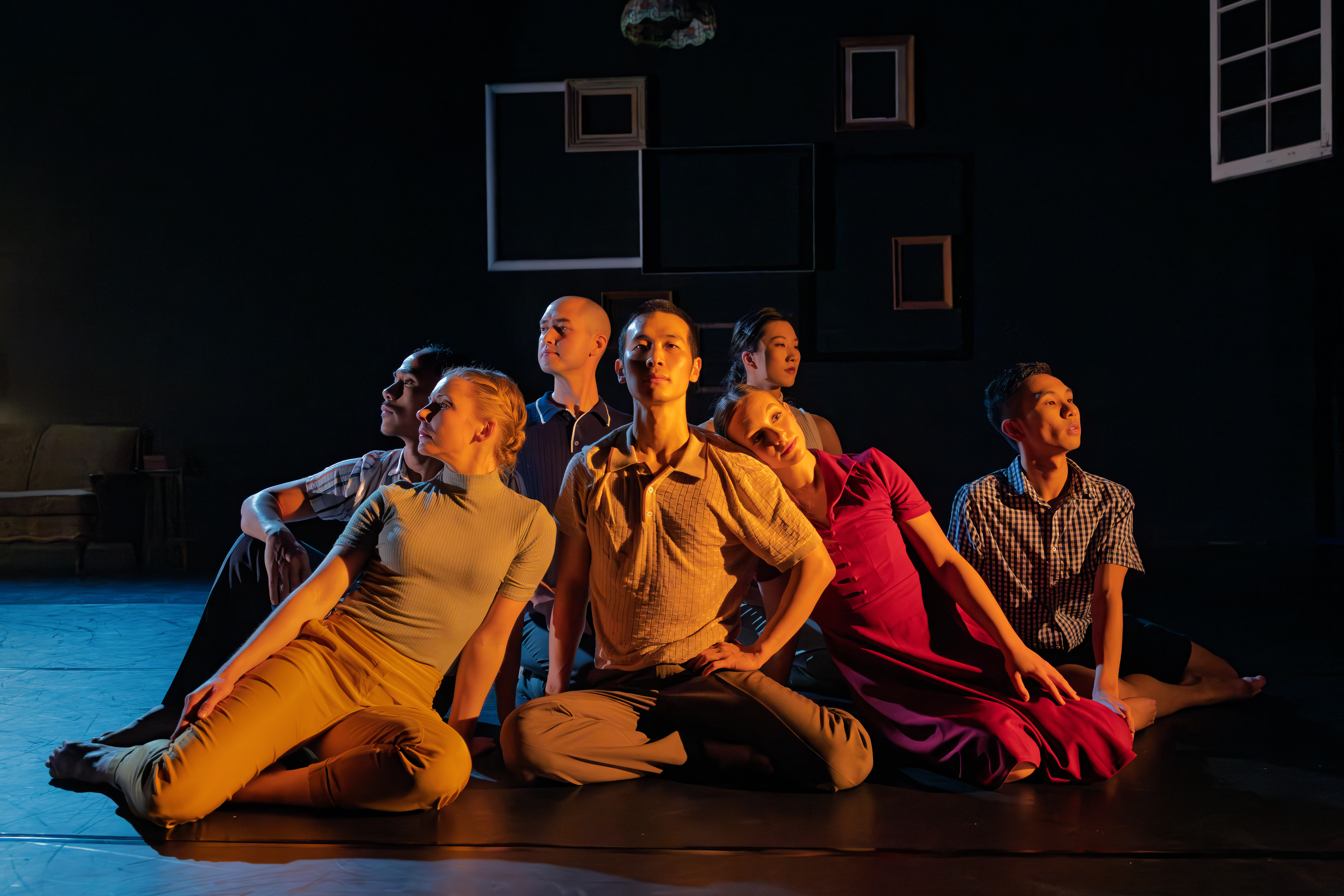
Nostalgia is the word that comes to mind when reflecting on the performance of Home by Re:Born Dance Interactive and choreographer Boróka Nagy. A cast of nine performers (Jonathan Bahn, Jestoni Dagdag, Krissy Gullen, Simon Harrison, Kristy Hwang, Katie Marshall, Boróka Nagy, Hyoin Jun, and Katie Walsh) were clothed in dresses and slacks reminiscent of a bygone era when women wore collared dresses and men and boys tucked in their shirts. Additional scenic elements included a table with a tablecloth, three sets of overhead table lamps, a set of empty picture frames, two hanging window frames with glass, a wall of standing floor lamps, and a brown couch with a side table. Altogether, there was no doubt that we were in a home—or perhaps a history of homes.
Starting the show with a music selection by The Little Dippers (a singing group from the ’50s and ’60s) further rooted the home in a sense of memory and hinted at a world like Leave It to Beaver, where the nuclear family was at the forefront and traditional roles within the family were strictly adhered to. The dancing, while fresh, was also firmly rooted in the modern dance lexicon and storytelling techniques.
The opening duet performed by Harrison and Walsh was playful and fun, including Walsh rolling over the back of the couch into creative configurations of partnering. The duet was sweet and intimate without being overtly romantic. There were quiet moments of closeness as they lounged in positions of rest with heads inclined toward each other. Nagy’s keen sense of design and space was ever-present in the work. The partnering was precise and clear, with a sense of power and shape.

Photo by Skye Schmidt Varga.
The strong partnering extended as a theme through the show in sections entitled Father-Son, Interdependence, Piece by Piece, and Mother-Daughter, among others. The height differences among the cast were used beautifully and navigated with a sense of equity and balance. Some lifts were just downright impressive, including Nagy holding two of her “daughters” on each hip for a sustained time. The physical endurance and power of this cast were beautiful to watch. The style of the work included a lot of uplift in the torso, and thus the partnering at times had a balletic (or what I saw as a classical modern dance) aesthetic, while still being soft and expressive.
The show was performed in two halves and included seventeen sections in total. It was a bit of an epic drama in that way. Each section shed a little light on the nature of these individuals and their characters. We learned more about the relationships between the characters and perhaps the histories that led them to where they are now. I found myself drawn into the work as I tried to determine who was who in the family and how they felt about each other. Because the cast appeared largely of the same age (adult dancers), it made the challenge a little more difficult. By the end, I had it mostly figured out, but there were a few question marks left that were a little dissatisfying.
What was hugely satisfying was the tremendous athleticism of the dancers, balanced with Nagy’s stylistic preference for long, clean lines and resonant shapes. The trend of shape flow (where dancers ooze and melt around in amoebic fashion) has become so prominent in the current L.A. dance scene that it was refreshing to see a work rooted in still shapes and the simple beauty of the body’s geometry. Nagy’s use of shape was purposeful and poignant within the narrative. The stories of the characters mattered as much as their beautiful extensions and buttery floorwork. I found Nagy’s vocabulary visually appealing—and perhaps also a little nostalgic—as it reminded me of an era of dance-making before contemporary dance (with a capital C) emerged on the scene.
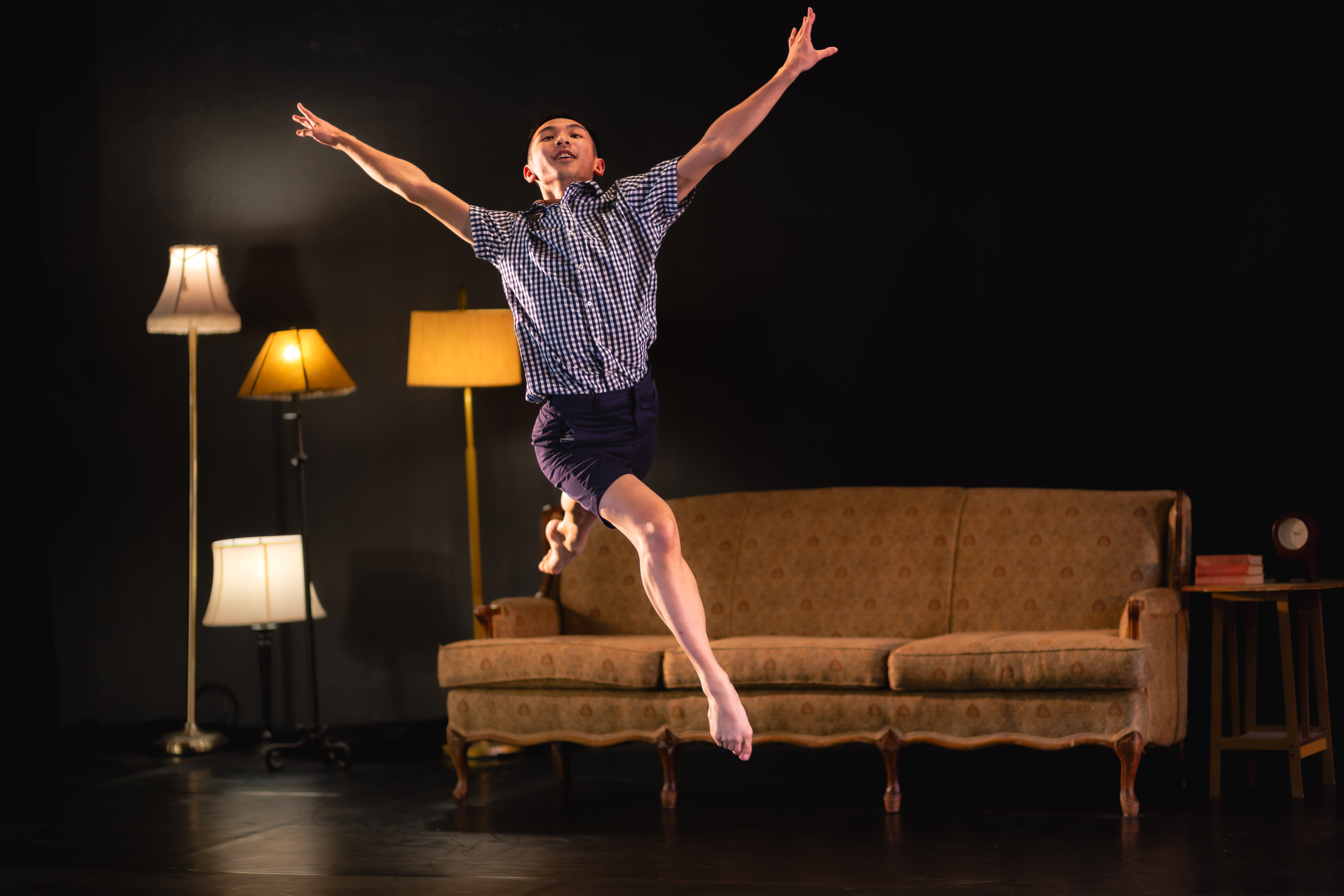
Photo by Skye Schmidt Varga.
The sense of line and geometry was also present in the show’s extensive airwork! Many current choreographers have moved away from springing and, specifically, big leaps, so it was exciting to see airwork used in an expressive context. And it worked. Nagy has a cast of dancers who are able to spring in bold leaps before spiraling to the floor for a demanding floorwork sequence. The contrasting use of space allowed for a wide range of expressive potential, as well as the sheer delight of big movement that is well-executed. In particular, I noticed that the dancers landed with ease and quiet—but then I noticed they were too quiet, even for dancers with great technique. I then determined that this floor was likely not a sprung dance floor. This is a shame. I love the Odyssey Theatre, and their dance series is a beloved gem in the L.A. arts scene, but it is another reminder of how hard it is to meet the needs of a sustainable dance space. These dancers did not hold back at all, and, seeing as I was at the closing performance, it seemed their incredible athleticism was able to sustain a full weekend of performances.
That said, two of the most memorable sections in the show did not include extensive springing and were set at the dining room table downstage left. At the Table held all the tension and frustration of a family trying their very best to get by in difficult times. The use of the gaze to direct the drama was paired with creative use of the table—almost like a gymnastic apparatus. The table was sturdy enough to hold the weight of the dancers while they leveraged their body weight in inversions and postures that communicated the internal struggle of coming together to sit at the table.
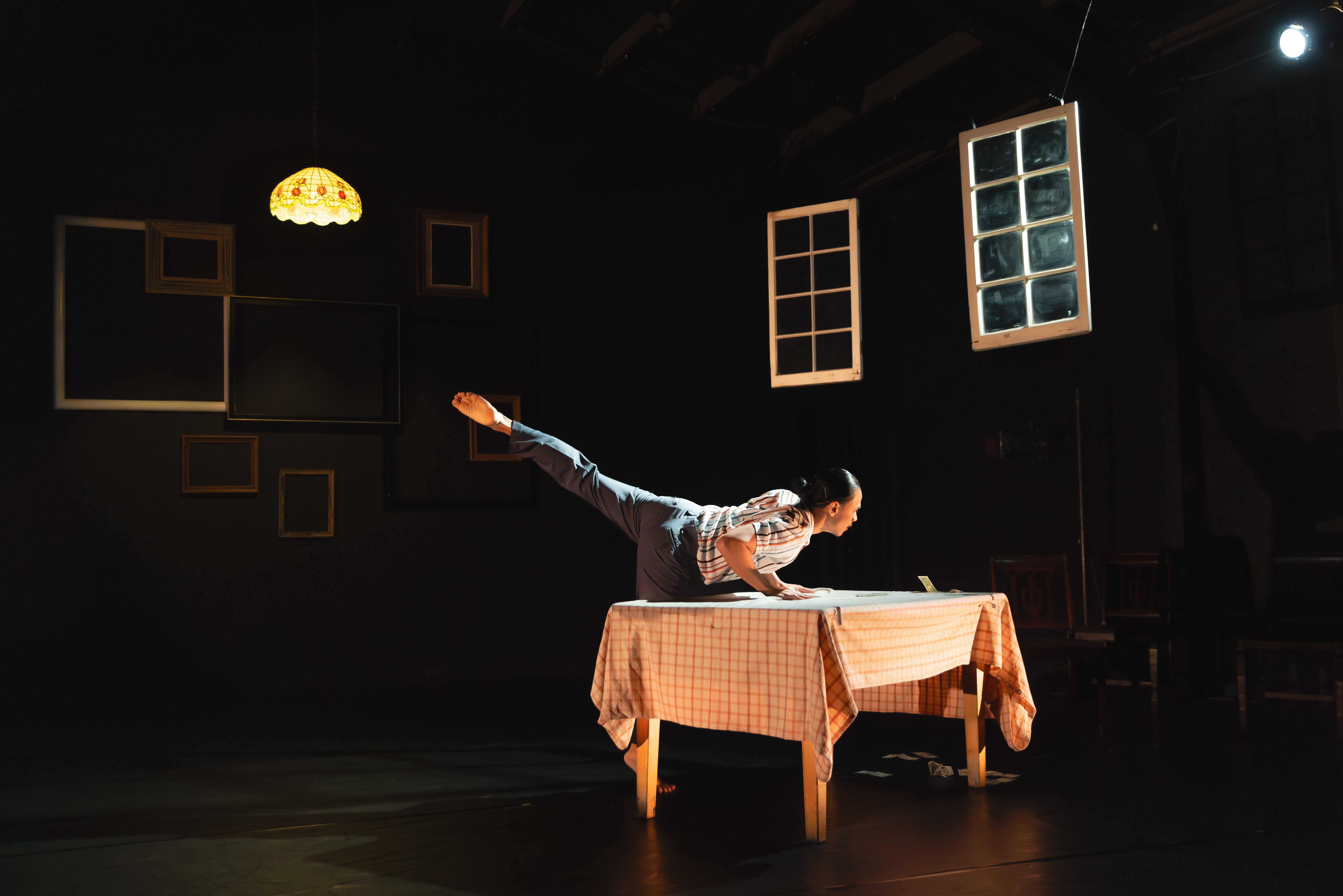
Photo by Skye Schmidt Varga.
Similarly, the solo Counting Money by Dagdag utilized the table for its emotional content as he sat counting out money for something meaningful (the rent, the kids, tuition, medical bills—it was left open to interpretation). But we heard the street soundscape in the background and felt the loneliness and desperation at that late-night table. Dagdag is an incredible performer who encapsulates a unity between inner experience and outer expression in a way that is rich and raw. His physical strength in inversions on the table contrasted nicely with his flow in phrase work away from the table.
Nearly each of the dancers had a solo at some point in the show, highlighting a balance between the individual and the ensemble nature of the company. The solos allowed the audience to see each dancer as a unique and personalized entity, which was critical to the work. The solos also allowed us to see the unique strengths of each dancer: Harrison for his command of length and line, Banh for his sprightly airwork and gymnastic flair, Hwang for her grace and flow, Nagy for her sculptural power, Jun for his versatility, Dagdag for his balance of stability and flow, Walsh for her sweetness and character, Gullen for her dynamic strength, and Marshall for her gravitas embedded in rock-solid technique.

Photo by Taso Papadakis.
The show as a whole was well-paced despite being a longer work (nearly two hours). The collage structure of the work did become a bit fatiguing, as there wasn’t a single driving narrative to propel the story forward into a climax and resolution. The show was organized into parts and further into chapters. Each part and chapter had a title and quote. These aided the comprehension of the work immensely and allowed the audience to look for the story and find it for themselves.
Lighting by the Martha Carter suited the old-timey feel of the work, focusing on a neutral palette of light amber and cool blues that kept the performers human while accentuating the drama of their inner worlds—sometimes warm, sometimes cool or conflicted. The highlight on the table and the lamp pointing through the window frames added dimension to the space, as well as a sense of place, as we could feel the days passing inside this little house as it was illuminated by the sun, moon, and lamps inside. The wall of lamps was a fascinating design element that contributed to the universality and abstraction of the theme. It seemed the lamps represented all the homes of all time: some cozy, some classic, some modern, some pragmatic. Unfortunately, the lamps were not used practically (meaning the dancers didn’t turn them on or off). Perhaps my theater background primes me for this sort of use of lamps, so it was something I noticed, although it didn’t detract from the work.
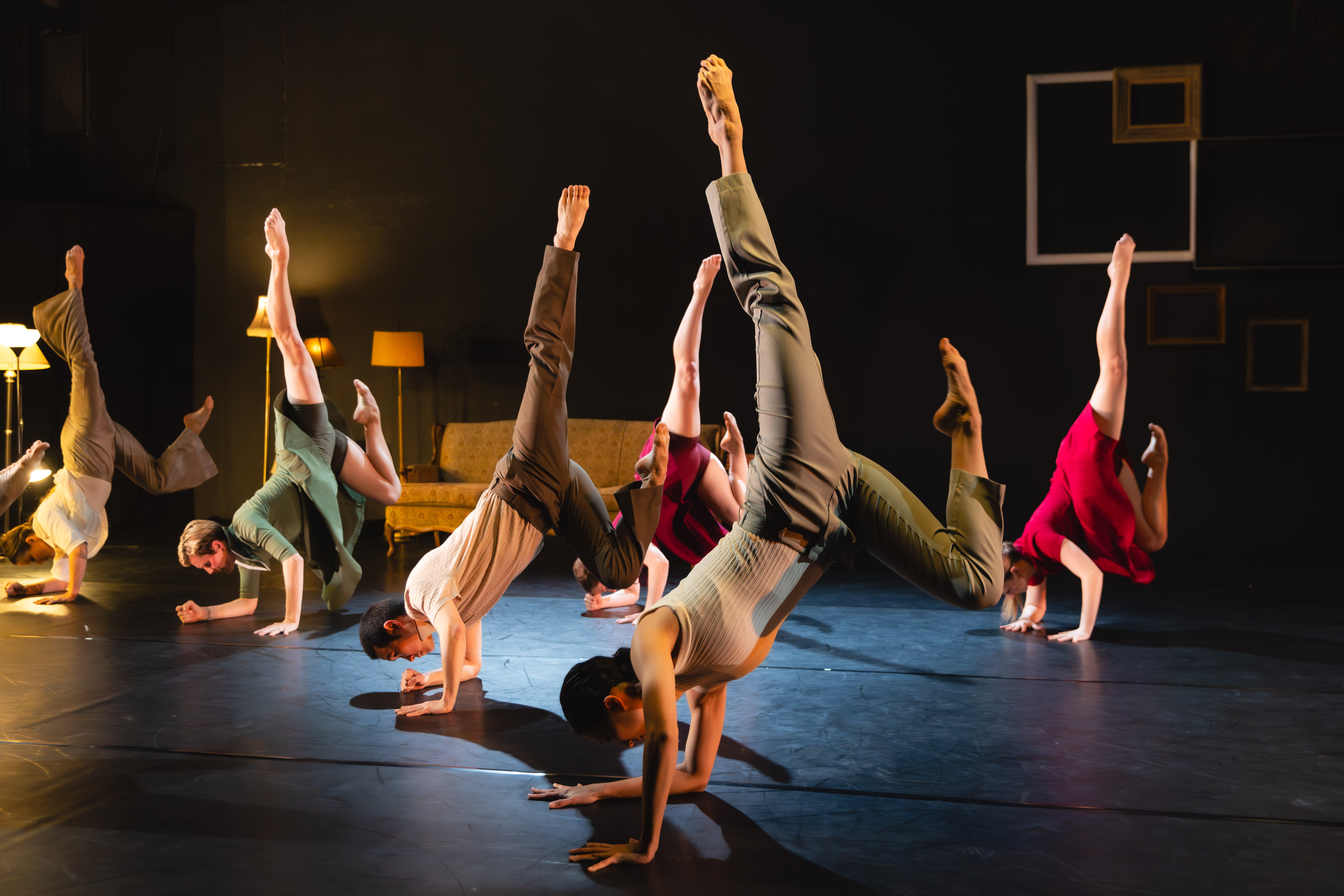
Photo by Skye Schmidt Varga.
Overall, the show is something I would joyously recommend to a wide audience. In fact, I was sad I hadn’t brought my 8-year-old son along because I think he would have enjoyed it, too! The composition of the work was coherent and filled with hope and humanity. It had heavier moments but ultimately resolved with an acknowledgment of acceptance for the life’s journey we all share. We all come from somewhere; we all have a family, whether by blood or by choice. In a time when the world is facing strong divisions, this afternoon of dance reminded me of what we share and how important it is that we honor the ties that bind us.

Photo by Taso Papadakis.
Edited on 2/12 Festival Lighting Designer was Katelan Baymer and show Designer was Martha Carter. Festival curated by Barbara Müller-Wittman.


 LA Dance Review
Leave a comment