Led by choreographer and director Seda Aybay, a cast of six incredible Kybele Dance Theater members transformed Highways Performance Space into an alchemist’s laboratory in a show titled Simyaci (Alchemist). Turkish-born Aybay designed and led the immersive movement experience, which included a pre-show video, guided movement opportunities, spontaneous duets with audience members, and a culminating follow-the-leader session for the entire audience. The show promised the alchemy of transformation through movement, evoking change in oneself and the world through an artistic experience– a noble and exciting endeavor to witness and experience firsthand.
The event began in the lobby, where improvised videos of the performers wearing their all-black costumes and steampunk goggles were projected on the walls, accompanied by an electronic voice-over explaining essential directions for what to expect. The disembodied element of the opening was a provocative setup for the body-centered experiences that were to follow. Without speaking, the dancers invited individuals to participate; it was the audience member’s choice to participate or simply observe. The video by Carl Owens was beautifully captured and projected; however, it was difficult to hear the text over the din of the crowd. The screen-reader voice also made comprehension more challenging due to awkward phrasing and tone.
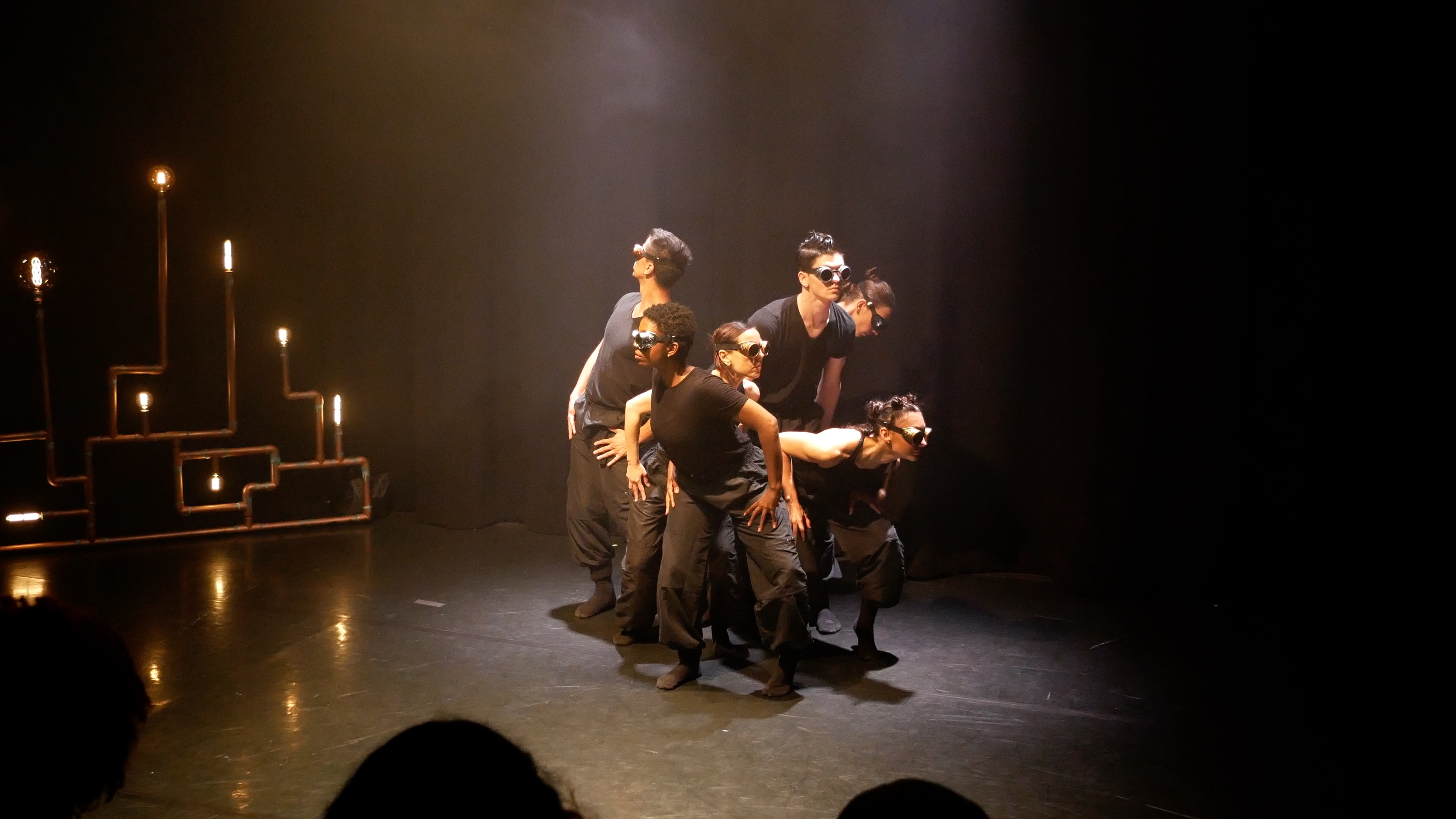
When the main event began, performers Ariel Scott, Nico Albuja, Simon Lathrop, Jade Lelievre, Huri Murphy, and Seda Aybay (listed in this non-alphabetical order in the program) entered the lobby to take individuals by the hand and guide those who accepted into the performance space. I was selected and joined the first group onstage, posing with my hands shaped like goggles over my eyes. There were a series of different still poses, and the process took perhaps five minutes. Audience members were moved with the dancers’ hands as well as through modeling. Then each was led back to their seats. The still shapes reflected the gestural motifs of the opening section, giving a taste of the work to come.
The opening section, entitled Endless Cycles, was an elegant construction of gestural phrasing using theme and variation. Shrugging shoulders, slicing hands, jerking arms, and mechanical torsos built a post-apocalyptic world in a Matrix style. The set dressing by Adam deFelice included a network of metal piping and incandescent bulbs that evoked an era of grit and ingenuity. The aesthetic matched and amplified the industrial feel of the steampunk goggles and sleek hair styling worn by the cast. Simple black t-shirts and tank tops worn with black pants and socks added to the uniform nature of the cast and the minimalist design of the world they were building together. The performers wore flat, serious expressions but broke into feverish shaking, scratching, and writhing, showcasing a clear breaking point in the rigid structure they had established through the gestural phrases.
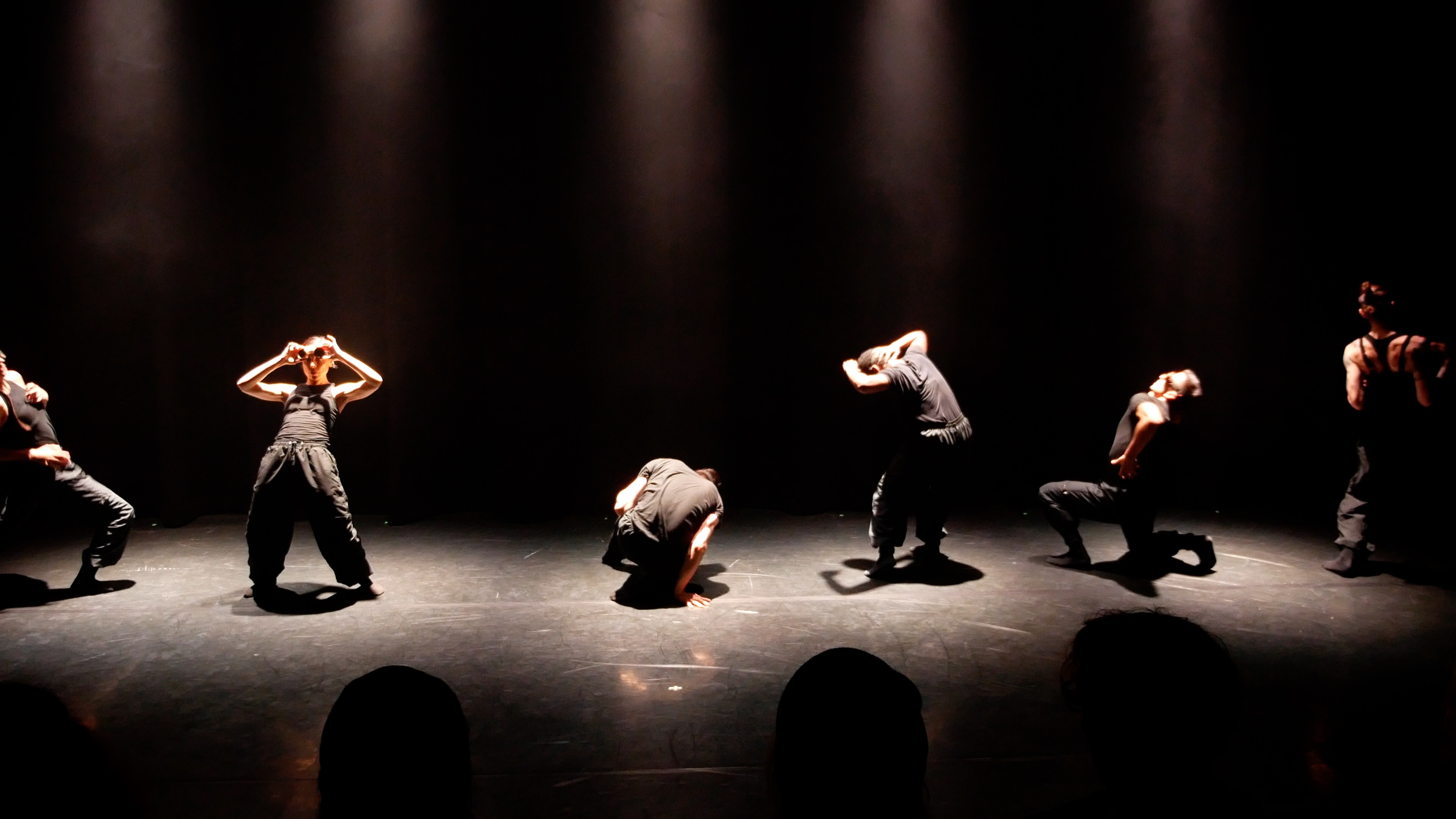
From this opening place, the piece developed into a sequence of solos, duets, ensemble sections, and audience participation through which the goggles were eventually taken off as an awakening to the world around them, and the movement softened into what I consider Aybay’s signature style. The shift from mechanical and frenetic actions into a world of breath and goo began with Aybay, who first lifted her goggles and then replaced them several times during her strikingly athletic solo. A strong inhale paired with the lifting of the goggles reinforced the metaphor of revelation. Through many different sections and partnerships, the dancers then began interacting with each other through sequential connections of hands, then arms, and then torso and bodies until the movement developed into full-fledged contemporary partnering. Aybay’s petite stature paired with her strong physique made for a jungle gym of partnering combinations. The rest of the cast was equally adept with the demands of contact improv-based choreography, making the partnerwork feel organic and seamless. Each of these sections had a subtitle in the program: Fear of Stepping into Unknown, Searching For…, Spaces of Silence, I Can’t Let Go of the Past, Change is Inevitable, and Golden Compass.
While the titles implied a progression, the movement style in these sections remained largely constant. The need for variety was met as each performer or combination of performers offered something tantalizing to enjoy in their performance. Also, bringing the audience members onstage in what were identified as “1:1 immersive experiences” provided lovely variety to the stage. However, I struggled to match the sections with the program since it was presented without breaks or pauses. The abstracted and minimalist theatrical elements didn’t support a theatrical narrative of transmutation as implied in the title. Since much of the material showcased the strengths of the dancers from the beginning, it resulted in a performance that was more a collage of sensibilities than a linear progression.

The dancing was stellar across the board; a beautiful duet by Ariel Scott and Simon Lathrop, with one goggled and one without goggles, made a clear statement about different perspectives and perhaps clouded judgment. Solos by each performer were breathtaking as each showcased their exquisite technique in a fabric of sensitive, elegant transitions. Hinges, falls, multiple turns, off-kilter extensions, and sweeping spirals made for eye candy moments that could be appreciated by a widely diverse audience. The 1:1 immersive experiences were also fascinating to witness as occasionally audience members were invited onstage and led using body-to-body contact through simple shapes, easy weight shifts, unified gestures, and relating moments. The audience members became part of the ensemble-cast in a delightful way.
Act One concluded with a stunning movement theme of dancers reaching in whole-body extension along the diagonal and then traveling backward and falling repeatedly. Reaching toward Aybay in the corner who was waiting somewhat stoically to grasp their goggles, they continually strived for the corner only to fall back again and again until finally each had given up their goggles to Aybay, making me wonder who was the alchemist in this world? At this point, for me, the narrative of the piece was largely resolved and forward momentum of the work ceased. A giant unison phrase to finish the act wasn’t needed and in some ways detracted from the nuanced movement material offered up until this point.
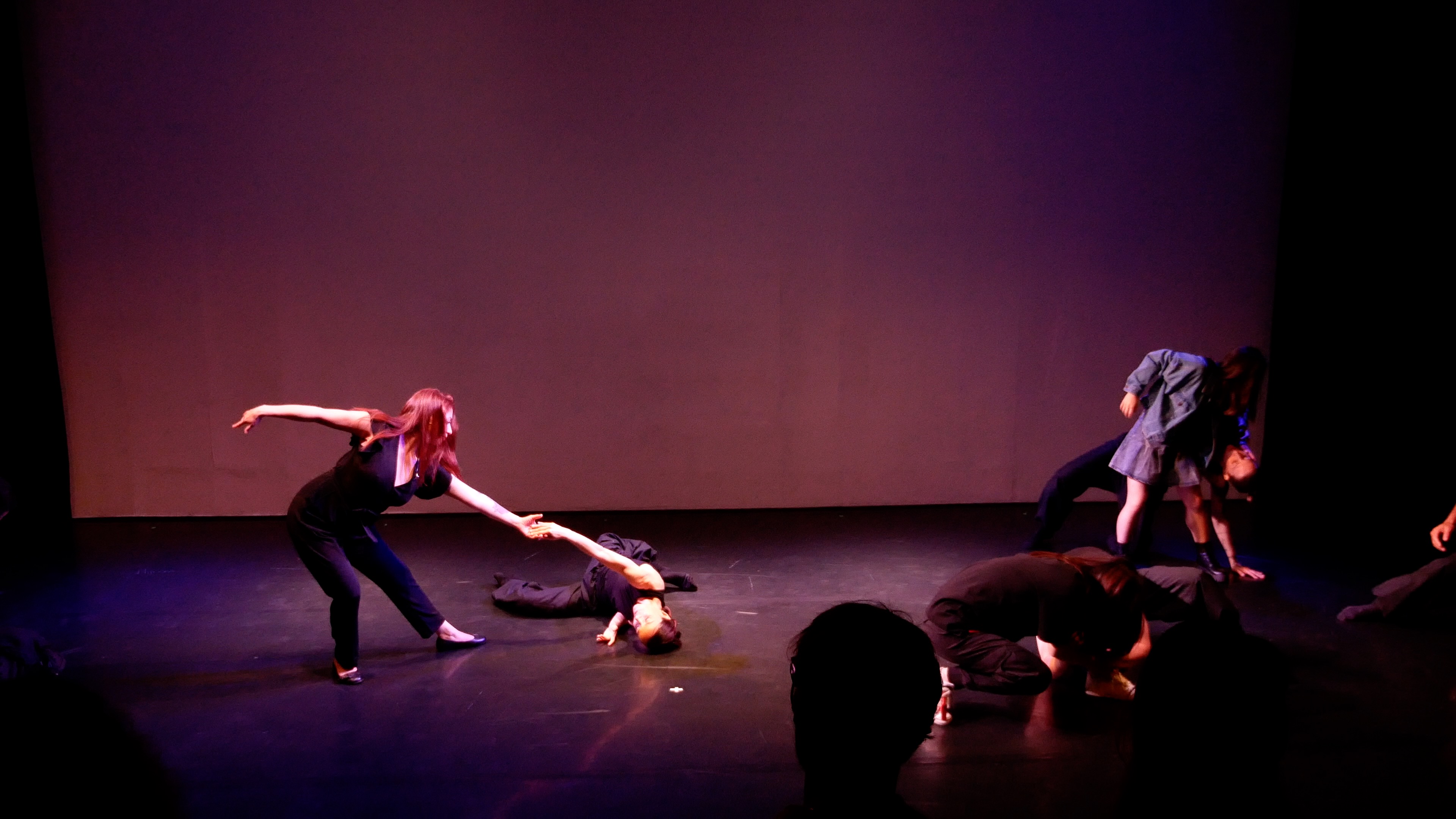
Intermission in the lobby can best be described as a big improv jam. Simple mirroring activities and essential contact partnering games got most, if not all, of the audience members moving at some point. Each of the dancers took time to connect with different individuals and thus get everyone engaged. The music now in a triple meter made this experience feel even more gooey and hypnotic. After some time, the audience returned to the performance space, which had revealed a white back wall and the absence of the lighting structure from the corner, a choice I questioned because the structure so beautifully represented the concept of enlightenment, and I was sad to see it go.
Act Two became another showcase for the dancers’ beautiful contact technique. Pairs of dancers performed in different combinations all firmly rooted in a spell drive (consisting of flow, space, and weight). Time only reemerged for the final unison piece which again returned to a steady 4/4 meter and a minimalist techno-feel. While all of the dancing in the second half was absolutely captivating to watch from a relational-body perspective, the narrative had at this point dissolved. Spell drive (from Laban movement analysis) is a movement profile that is by nature enchanting due to its constant use of flow and earthy use of weight. It has a hypnotizing effect and since so much of the dancing was characterized by spell drive, it challenged me to stay alert and present.
But the lulling, relaxed state was arguably essential for the audience to be at ease and ready to engage with such an intimate immersive structure (even despite it giving off flashes of cultish vibes). A culminating moment was when an audience member was invited to perform a contact improvisation with Aybay. While it was exciting to see the audience member work in real-time with Aybay (clearly the individual had dance experience under their belt), I wasn’t sure how this duet built upon the high-point improv session experienced during the intermission.

The program identified another set of multiple sections in Act Two including: Fundamental Values – Love, Fundamental Values – Gratitude, Fundamental Values – Reverence, Fundamental Values – Compassion, which are all beautiful sentiments, but unfortunately, I wasn’t able to connect with them as distinct and disparate values (perhaps I was caught in the spell!). There was a lovely duet by Aybay and Lathrop set to an interesting version of the song featuring the melody of My Funny Valentine, but I wasn’t able to figure out what section of the piece I was in at that time. Other section titles included Spark of Life/Energy, Rhythms of Inner Harmony, and Alchemy Within. Despite whatever disconnect I was feeling between the program outline and the performance, the dancing was lovely and the inclusion of audience members was fun to witness. Ultimately, I had to let go of trying to track the show and just enjoyed the rest of the ride, which was exceedingly generous in length (over 90 minutes). The need for the duration was also something I questioned as the dancers were rightfully fatiguing particularly in the final unison section that seemed relentless in its aerobic demand.
The work closed with the entire audience being invited up for a follow-the-leader dance moment. Aybay was the leader, and we all copied her. It was fun to see so many bodies moving and faces smiling. I imagine this was more dancing than some of individuals have done this week, or year, or lifetime– my mother-in-law included! For those already in the performing arts, I wonder how much alchemy was experienced. The structure of follow the leader has its limitations for personal and even communal connection. It seemed the spontaneous and diverse Lobby improv may have been a more effective ending for the Alchemy Within. Nevertheless, it was still great to see the stage full of moving bodies coming from many different backgrounds and contexts.
Immersive and collective movement experiences seem to be the order of the day in LA contemporary dance. The last review I wrote was for Bodies in Play, and it also had a strong participatory component. I see the incredible benefit of getting the audience engaged physically and mentally as part of a dance show. Audience members have, in general, become too complacent, too disengaged, too trained for apathy as a result of screen-based media and overexposure to sensationalism. Aybay had an ingenious vision to get more people moving and experiencing the magic of contact improvisation first-hand, plus it added a fascinating and effective texture to the evening work. In some ways, I recall the audience members’ movement more clearly than some of the dancer moments because the audience members looked different, with different types and colors of clothing, body shapes, and energetic profiles. And the resulting appreciation of the work was palpable; the audience members felt needed; they were needed to make the show happen. This was perhaps the real alchemy of the evening, the audience noticing how much they matter to a dance performance.

Kybele is another feather in the cap of the current Los Angeles contemporary dance scene. The company is exquisite, and Aybay continues to be an absolutely beautiful performer as well as a compelling movement maker. Lighting design by Darren Carter stayed simple with neutral warm and cool tones in the first half followed by additions of deep blue in the second half. Music by Nils Frahm, Anne Müller, Adam Crawley, Rival Consoles, René Aubry, Dustin O’Halloran, David Schoch, Alva Noto & Ryuichi Sakamoto, and Joep Beving matched the mostly industrial aesthetic of the evening and the driving energy of the work through minimalist structures that were largely electronic. Senol Aybay consulted on the costuming which worked particularly well in the first half but may have undermined the second half by remaining the same. The finesse of the event as a whole can be credited to the company’s Executive Director Lori Tilkin and the leaders of Highways Performance Space, Leo Garcia and Patrick Kennelly.
Overall, the evening was a tremendous success, doing its part to re-engage an LA audience for dance and deliver a performance that was both intriguing and adeptly performed. Highways was a lovely venue for the avant-garde feel of the work and the intimacy of the evening. The proximity of the dancers to the first row of audience was an asset when needing to bridge the gap between performers and audience. While this was my first time seeing Kybele Dance Theater, I am curious to see more of Aybay’s work and learn more about the scope of her artistic offerings.


 LA Dance Review
Leave a comment