This March, the 8th Annual International Women’s Day Dance Festival, produced and coordinated by MashUp Contemporary Dance in Los Angeles, featured another stunning showcase of female and non-binary choreographers. The weekend included many events, including classes, workshops, and discussion panels, surrounding the essential topic of access and inclusion for women in dance. This year, the cornerstone performance event included eleven works by eleven choreographers to satisfy the hungry audience at Stomping Ground performance space.
With such a large and varied program, I will speak briefly to each of the works, then to some themes and considerations that stood out to me while experiencing the show as a whole. For detailed programming of the event, please review the digital program here.
The show began with Waeli Wang’s “I Crossed an Ocean for You,” a lovely quartet of dancers evoking imagery of journeying through small stepping pathways and devotion through uplifted palms. Wang’s strong use of circling in the arms and lunging in the legs made the piece feel sweeping and fluid. The varied black and orange costumes allowed each of the dancers to be seen as individuals while sharing commonalities. Featuring an abstract structure, the piece held space for interpretation in the narrative loosely based on the histories of the many immigrants arriving to this land over many centuries. What was most clear was the unified sensibility and spatial intention of the dancers as they explored individualized movement vocabulary.
Kaley Logan presented an extra-large ensemble work entitled “Kairos” that utilized the cast of seventeen dancers to create landscapes of movement accomplished through various groupings of dancers in the space. Highly skilled movers, the large cast was dressed in a variety of tan, brown, and blue button-down shirts and pants. Logan’s predilection for gooey contemporary vocabulary was evident and contrasted nicely with punctuated gestures and shapes that accented the singer-songwriter accompaniment. The value of the music as inspiration was clear both in the textural compositions of the dance as well as the phrase work of Logan’s solo near the end that highlighted their control and expressive potential within the current LA industry dance trends.

The solo rendition of Marcella Lewis’ “Spectacle of Ritual” was a particular treat. The soloist Marirosa Crawford was nothing short of outstanding. Sadly, the sightlines from my vantage point were poor, and I missed much of the opening and closing moments in the downstage left corner. The conservatively cut dark blue satin dress placed me firmly in a church-going world, and the motif of clasped hands and a bowed torso made clear the theme of humble prayer. But what started simply and patiently developed into a mesmerizing performance of Crawford with explosions of movement and effortless extensions that felt exquisitely timed within the development of the work. The journey of the individual through revelation and release was one I would like to see again to better appreciate the nuance of the choreographic design.
Hannah Millar shared an innovative ensemble work entitled “BOXED” that utilized bound flow and strong body shapes in close unison formations. The dancers, dressed in black, evoked much of what is valued today in industry contemporary dance. They were excellently trained for spatial, rhythmic and expressive precision. Repetitive jerking of the head sideward or arm gestures gave this work a strong sense of urgency and panic in being trapped. Millar explored mimetic gestures for being boxed in as well as large-scale imagery such as having dancers walk sideways on the sidewall of the performance space. Ultimately, the dancers were able to see the light (after the brief use of a flashlight prop along the back curtain) and attempted to break free.
“Hapa” was an thrilling choreographic contribution by Polynesian fusion choreographer Tori Cone. The piece was driving and rhythmic with an authentic sense of joy coming through expressive ripples of the arms and hands, contemporary modern phrase work, body percussion, and lively shouts. The black one-shouldered dance costumes, leaf-like wrist adornments, and red, feather headpieces rounded out the fusion form and honored the balance between tradition and contemporary vision in Cone’s creation. Certainly, the drumming grooves by Polynesian band Te Vaka uplifted the spirit of the night into a place of joy and celebration.
Gianna Burright shared her familiar choreographic elegance in “To Yell in Quiet Places.” The cast of six female dancers embodied Burright’s love of mid-twentieth-century music and costume aesthetics while utilizing dance theater structures, including theatrical props, spoken word, and luscious contemporary partnering. The use of both fresh wildflowers and red roses made for a whimsical and romantic outcome that suited the pastel slacks, skirts, vests, and blouses worn by the dancers. Plucking petals, showering them from inside an umbrella, and tossing them through the space added lightness to the evening that was much needed. The excellent technique of performers allowed for airy tip-toe walks through the high level as well as supple floorwork. Their additional ability to play with facial expressions and spoken word (“Where are we?”) made the unique world of this work come to life.
Having just seen Azuki Umeda’s evening-length work “How I Became Kinder, and Kinder” at the Odyssey Theater, it was lovely to see another work of hers. “Do You Trust Me?,” A duet performed by Nanea Yu and Ande Godwin was true to much of what I have come to expect in Umeda’s work. The duet began with Yu lying prone on the floor, crawling with a heavy desperation before a swift-footed character in white slid into the space and thus began the duet of bodies through space holds and detailed interweaving of limbs framing popping isolations of the central body. What was most refreshing about the work was that the female duet did not seem decidedly female or male. The casual costumes of pants and tank tops made this dance feel non-gendered and asexual in tone, which was a nice break after the many works with messages of femininity and female empowerment.
Jordan Pelliteri presented a second solo of the night entitled “V” performed by Ella Horan. The audience simply could not get enough of Horan’s adept performance, which included a mix of near-contortionist back attitudes, handstands, and krump (I think that is what I saw?). The juxtaposition of the classically beautiful young blonde dancer in a black satin cocktail dress, gloves, and stilettos with what evolved into a stamping, thrusting, shuddering body was remarkable. Set to a techno beat with German spoken lyrics, the harshness of the movement quality with the music converted this sleek petite figure into quite the powerhouse you wouldn’t want as an enemy.
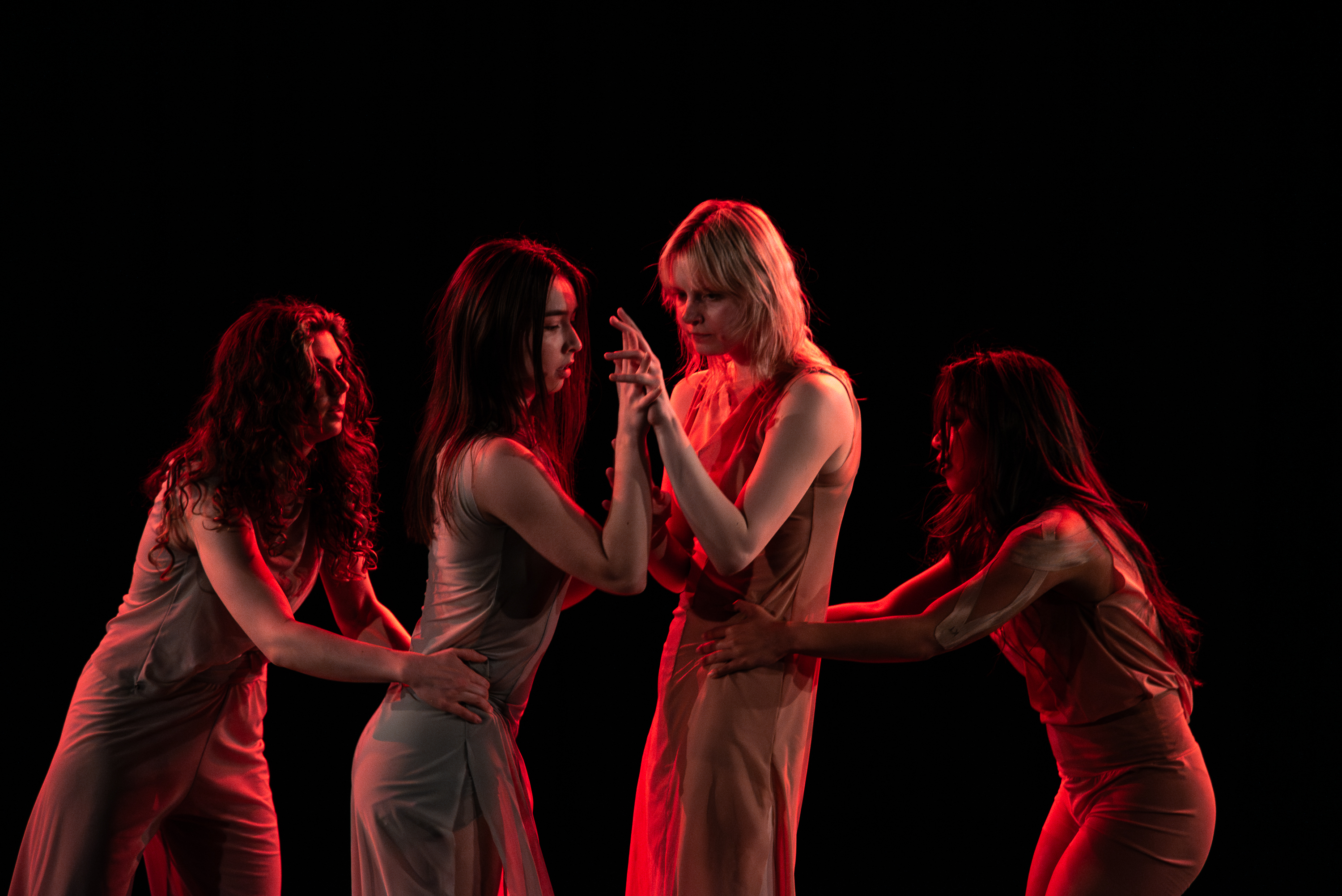
A female quartet, “Lilith in the Garden,” was choreographed by Madison Olandt and performed by MashUp company members. Dressed in sheer mesh fabric in dusty blue and pink, the quartet wore much-needed knee pads to allow for the repeated collapses to the knee as part of the choreography. The structure of the work tracked a collage of images including slicing blade arms, gestures of donning earrings or lipstick, dropping to the floor suddenly, and melting into the arms of a partner or group. The contrast organization and reorganization of the four women into pairs (sometimes matching costume color and sometimes not) played with the traditional color association of boys and girls; however, the result became a story of romantic love between females, perhaps with differing inner worlds of masculine and feminine.
Olivia Liberati brought Little Italy to the stage in her business attire-clad quintet “Mafiosi.” Liberati set the stage with a plastic folding table and five folding chairs. We were clearly in a boardroom, and these characters were at war. The movements were percussive and powerful with direct focus and high-impact dynamic phrasing. Moving away from the table, the dancers maintained the intensity, each having a moment of shine in a solo before returning to the table for a final battle of wills. Liberati has a strong sense of power in her movement that is matched by nuanced refinement in execution. The movement was potent without being overdone or labored. There was finesse inside the dancers’ performance that reflected contemporary movement trends and proved most compelling when supported by the rise and fall of the emotional content of suspicion, alliances, and ultimately betrayal. The only question that surfaced for me was the choice to have the murdered dancers come back to life to complete the dance.
The show closed with Jasmine Albuquerque’s “Miniature Death” with good reason, as this piece would have been a tough act to follow. After an extended music intro in darkness, the lights came up on a high-heeled Albuquerque, wearing black panties and a button-down shirt tucked up under her bra exposing a large circle of red paint on her belly. The effect was immediate. This woman was unfettered and unapologetic. Albuquerque spent the majority of the dance seated on a stool while a quartet of women danced mostly in unison upstage of her wearing nothing more than black trunks and heart-shaped pasties in lieu of a top. The freedom with which this cast performed was captivating as they shook, flung, dropped, and bounced their bodies through the dance. I appreciated the overt display of skin and sexuality of these bodies as it directly connected to the story of the work. The orgasmic qualities of the movements became the dance as it rode the outrageous pounding music that transported the audience into another world.
As with many festivals, the individual works are difficult to analyze as standalone pieces when framed by the presences of the others. In this case, feminist themes in an abstract contemporary dance framework performed by largely female casts with ferocity and high intensity dynamics became the status quo of the evening. The pieces that stood out in the concert then were those that contrasted the pervasive youthful feminist energy and avoided common contemporary movement vocabulary. Many major female topics were also not addressed in the programming including pregnancy, motherhood, child-rearing, and/or menopause. As a festival that celebrates all women and non-binary artists, I would be interested to see how more types of narratives and stages of female life can be represented in upcoming years. As it was, the concert had excellent contemporary dance artists on the roster, and each showcased their strength in movement design and creative vision. It was an honor to be witness to so many passionate female and non-binary artists who take such care in their work.
MashUp’s creative council includes Sarah Rodenhouse, Victoria Brown, and Stephanie Heckert, and they do an outstanding job in providing a venue for female artists to have a protected space for their work. Stomping Ground is an ideal space for dance with crisp lighting design by Caleb Wildma to support the evening of movement. Creative producer Faye Viviana had a well-organized event that ran seamlessly and entertained a packed house. All of this plus the incredible performances on stage prove this festival is a golden thread in the fabric of dance in Los Angeles and a testament to the power of vision and hard work needed for events like these to take place.


 LA Dance Review
Leave a comment