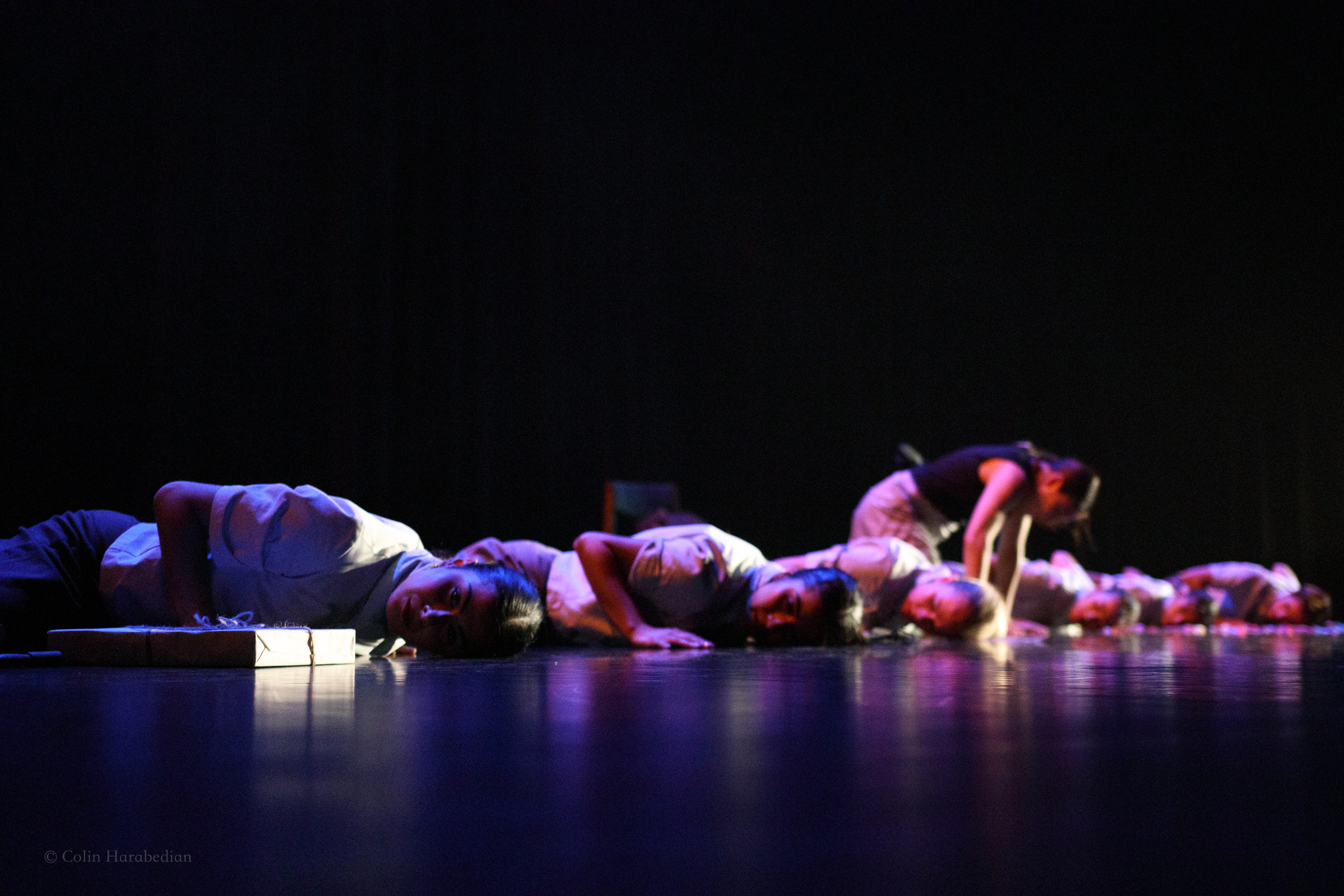
Azuki Umeda’s dance work, how I became kinder, and kinder, closed the six-week dance series Dance at the Odyssey last weekend at the Odyssey Theater. The evening-length work developed her Master’s thesis work from CSU Long Beach as a debut concert work in the LA dance scene. The result of two years of research, the realized performance reflected nuanced attention to both movement generation and abstracted imagery.

Performed by a cast of eight dancers, including Umeda, the piece highlighted stylistic and movement elements sourced from hip-hop, including animation, popping, and waving, while framing it in a contemporary concert stage context. Dancers Jordyn Apostalache, Dante Casarin, Tori Cone, Kamryn Funk, Ande Godwin, Isabella Mendoza, and Jennifer Vieweg performed the work with conviction and clarity, showcasing their unique abilities to isolate and flow within a hip-hop vernacular, as well as draw from contemporary dance techniques with multiple turns, quick tilted extensions, and finessed floorwork.
Umeda’s unique blend of hip-hop and contemporary made for many visually stunning moments. She used precise gestures, body isolations, spot holds, robotic rocking, and sequential flow through the torso and limbs to generate a unique world for the work. Clever movement invention appealed to the general audience members, soliciting audible reactions at times, while the whole of the work lived in a dance theater collage of time, space, and story that was abstract if not elusive.
The performance included themes of strained family relationships, connection, and disconnection embedded in an intimate world of self-reflection. The costumes gave a nod to Umeda’s personal family history as a first-generation Japanese American. Umeda and another petite female-bodied dancer were dressed alike in light grey and black kimono-style garments that wrapped across the chest and draped to the knee. Additional textile details and knee-length pants reinforced the Japanese aesthetic. The ensemble was dressed in wide-legged dark grey pants, pleated at the hips and tapered at the ankle, paired with a light gray blouse with a folded neckline giving the illusion of a man’s necktie (while still being one piece of fabric). The ingenuity of wrapped garments is something of a marvel to me, and I found the designs of the costumes beautiful and fascinating while also connecting me firmly to Japanese design and origami imagery.

The show began with a thick layer of haze in the air, reminiscent of marine fog, giving another nod to Japanese immigration to the California bays that saw the arrival of so many Japanese immigrants over the years. The haze offered an interesting playground for lighting designer Camille Roberts to transform the black box. Roberts utilized a predominantly lavender and rose palette for the majority of the show, peppering it with sudden shifts in the lighting direction and color at key moments to punctuate peak moments of the narrative. A favorite lighting moment was one in which Roberts manipulated the performance space into a world of rocking waves with alternating light from stage right and left. She also cultivated beautiful simplicity and intimacy through the use of warm, rose-colored pools seen in the final look.
Music arrangements by Lucy Liyou, Robert Gaar, and Azuki Umeda offered a widely varied soundscape for the work. The music included a number of glitchy electronic compositions which Umeda matched perfectly with choreographic visualization of the rhythms and textures. This relationship between music and movement is common to many current dance trends (seen in social media dance influencers, Cost and Mayor’s hugely popular embodiment of iPhone sounds and choreography of hip-hop idols Mari and Keone Madrid as mentioned in Umeda’s bio). Moments in this show felt like I was back at the Welcome to the 805 hip-hop festival last fall. Hip-hop crews trained in this type of musicality excel at embodying sounds with impeccable accuracy. Umeda holds her own in this world without question. She is adept at creating jerking, stuttering, sliding, rippling illusions of the body that are entertaining to watch for the mere ingenuity of design if not also for the content.

The mixed accompaniment also included spoken word in the form of (what seemed to be) journal entries read by a screen reader. While there was no clear plot to the work, the imagery evoked through the text helped propel the narrative with references to relationships and personal reflections that contextualized the struggle of the characters. The text was particularly useful in illuminating the possible identities of the dancers as well as their relationships to each other. Umeda’s costumed counterpart seemed to portray a younger Umeda as the daughter to two of the ensemble members although the relationships were loose and flexible.
Umeda contrasted the electronic music and computer-generated voices with piano recordings including ambient background noise of people or places that I couldn’t quite make out. The recordings were rough and rocky, unpolished and gritty adding to the rawness of the work while infusing a more natural human element to the piece. The solo piano music also lent itself to contemporary movement that was more internally motivated than design-driven.
Something about the music and the dance working together became hypnotic, and I found myself at times drifting into a space apart from the work I was watching. While the piece title implied a process of becoming kinder, I felt the arc of the 55-minute work was more stable than transformative. Touching moments of intimacy and emotional rawness were undoubtedly present, but I found myself unclear on the transformation as revealed through the movement itself. The final moment of the show reflected an uncertain resolution as the audience as a whole didn’t seem quite sure when to applaud.
Nevertheless, the work had lasting impressions that were intelligently crafted. For instance, the birthday scene complete with confetti cannons left an indelible mark as did Umeda’s subsequent sweeping up of the confetti into a pile which proved both difficult and ultimately fruitless. Similarly, the intricate interactions between partnering dancers were simply mesmerizing: interlacing body parts, space holding and spot holding negative spaces, and connecting and disconnecting in countless configurations. The qualities of bound and free flow worked in a nuanced relationship that created subtle texture in the dancers’ bodies as they visualized the musical arrangements of bells, clappers, birds, and electronics with impressive control. Additional movement signatures continue to resonate with me including: the rhythmic jockeying of the dancer’s weight back and forth in a mechanical energy, a repeated dropping inch by inch of the body downward like a puppet on a string, and multiple turns while looking upward.

One unique element I noticed in Umeda’s personal performance was her maintenance of her center of gravity over her feet while walking (often slouched or hunched due to the deeply rooted sadness that pervaded much of the work). Typically, the mechanics of walking include a moment of falling from step to step which allows for momentum to transfer and traveling to become more efficient. In this work, Umeda almost exclusively kept her center of gravity in balance while walking, creating bound flow in her gait that added to the sense of discomfort in her character. Yet, maintaining one’s center of gravity while walking is a common attribute to many Asian dance forms, and led me to wonder about its role in this particular work.
What was clearest for me was the intensity and vulnerability Umeda modeled in this work reflecting the mission statement of AU.THENTICITY DANCE CO. as a whole It was deeply personal, and, for much of the work, it felt personal and unique to her as an artist. This wasn’t a story of anyone who has struggled with feeling accepted and loved by their family, this was Azuki’s story. There is courage in telling our stories, and Umeda found ways to make the work personal without feeling gratuitous. I very much appreciated her honest approach in this work.
Sadly, Umeda’s dedication and care, shown in the origami bags she gave to each of the audience members at the top of the show which included a ripped page from her journal and a small note of encouragement on a tiny origami heart (how precious is that!?) was not met with equal care by the audience, many of whom arrived extremely late to the show (the start of which was already held 15 minutes). Because it was more than just a couple people, the late seating caused a significant disruption to the flow of the show. As a fellow performer, my heart went out to the cast at this moment. While I’m always so happy to see more people attending dance, I want to encourage audience members to honor the gift of live performance and the humans on stage by being punctual when at all possible.
In conclusion, the Dance at the Odyssey series curated by Barbara Mueller-Witmann is a treasure to the LA dance community. I’m only sorry I wasn’t able to see more of this year’s performances! 2024 marked the 7th annual season of the dance series and with good reason. The space is perfect for our community with steep raked seating, intimate proximity between performers and audience, a beautiful stage, and lovely lighting plot. Looking at the series as a whole, the programs seemed variety and diverse. I am excited to attend more shows next year and enjoy the plentiful offerings of these artists in our community.


 LA Dance Review
Leave a comment