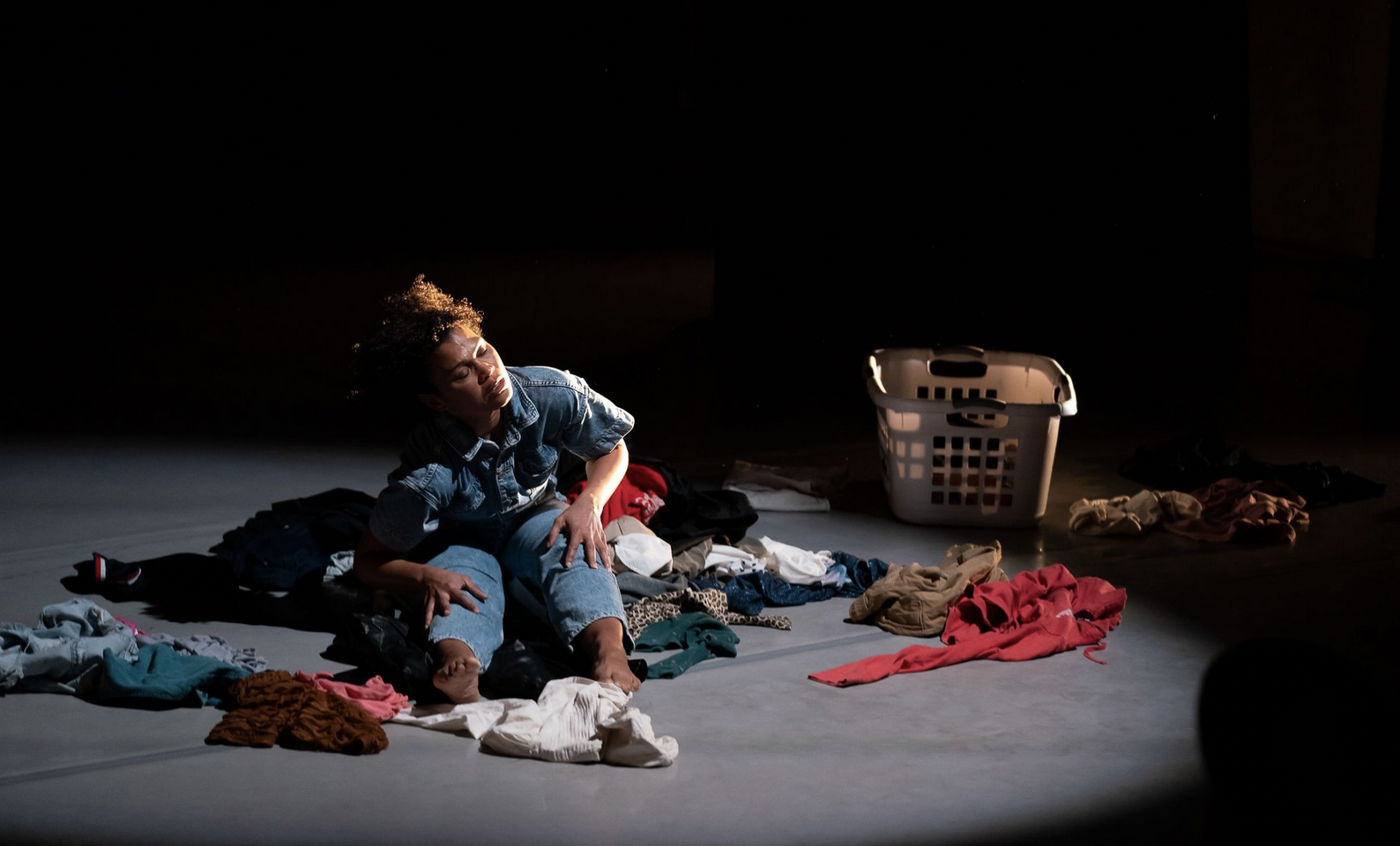
Summation Dance/LA enjoyed its West Coast debut performance last weekend at Los Angeles Dance Project, presenting an evening-length work entitled on our way home, choreographed by company co-founder Taryn Vander Hoop. The hour-long work was presented alongside a new piece by LA-based dance maker Derion Loman, entitled dirty laundry. Presented in the lovely downtown, black box theater at LADP, the sold-out contemporary dance show was an overwhelming success – intimate, personal, and reflective, while also being exciting, dynamic, and at times, even funny.

Loman’s work, dirty laundry, opened the show. The space was set with two lines of laundry strung up along the back curtain. Pants, shirts, and skirts were draped in earthy colors against the black backdrop. A solo dancer began with a shirt laid in front of her. She slowly reached for it, straightened it, crumpled it, lifted it, and smelled it. The movement was patient and simple, calm and internal. From the solo, the work developed into a female duet. They slid their arms into the shirts, wearing them backwards, embracing the memory inside. Sensitive sliding of the hands on the body was a primary movement theme for the duet, highlighting the texture of the shirt fabric and the easy length of extended legs in a sloughing off gesture. The dancers moved articulately with a firm sense of grounding, making their performance a joy to watch. The oversized shirts draped and flowed through space in neutral tones over a matching base costume of teal pants and fitted nude tank tops (costumed by Amy Kubat and Derion Loman).
The work introduced another soloist (a third dancer) who performed almost exclusively with her dark hair tossed forward over her face and her shirt on backward, creating an illusion of being the back of someone lost or departed. This dancer highlighted her beautiful length through loose-limbed gestures, unfurling extensions of the legs and arms, and deep wide stances. A witchy trio of dancers entered with their long hair also pulled forward to cover their faces, reinforcing the illusion of self and other in one body. They danced in close proximity to each other in lines and clumps, sometimes unified in intertwining shapes before punctuating the space with lightly executed battements. These dancers moved with bold and powerful energy, swooping across the dance space with big arcs and swirling spirals despite what seemed like a sticky marley floor beneath them.

The piece concluded with a driving ensemble section, with the dancers holding their shirts in their hands and repeatedly whipping them in the air. The sound of the shirts being tossed outward into the space and snapping back was one of the most fascinating aspects of the work, driving the work sonically as well as physically. The piece culminated with a series of primal screams by one of the dancers into her shirt as a final casting off of the memories living in these garments before they could be hung up “to dry” on the clothesline.
Loman’s work as a whole was an intriguing movement study in the many ways one can dance with a button-down shirt. The abstracted imagery explored through different relationships (addressing, grasping, supporting, whipping) with the shirts added depth and intrigue to the work, as each section seemed to explore a unique relationship to the memories residing in the fabric. The music by Ben Waters was often soothing and rhythmically stable, making the piece feel casual and contemporary. Sometimes the transitions between sections of the music and dance felt abrupt; however, the episodic nature of the music and the choreography allowed for flexibility in the design of the arc of the work. The female cast of dancers from the company Two Point 4 danced Loman’s work with great integrity and conviction. It was unclear from the program how this work came to be and how Loman is connected with this particular group. But, the outcome of the work about remembering and reflection aligns beautifully with their company values of connection and curiosity as stated on their company website.

The first chapter of Summation Dance’s on our way home, entitled “The Miracle,” began with a shock as the lights popped up on the cast of dancers lying scattered across the stage in the fetal position and the sound of a heartbeat blasted from the speakers. We were in the womb; the dancers rolled back and forth, from side to side with propulsive energy in coordinated time. They then emerged into life – were born into their lives. The tone of the work was immediately captivating due to its dynamic relationship between rhythmic precision and timeless sensitivity; Vander Hoop’s ability to craft the bodies in space to create texture in time is a fascinating and compelling skill. The movement, while often simple in design, was composed in such a way that each moment developed into the next with ease and clarity. The commitment and skill of the dancers (Arletta Anderson, Kacie Boblitt, Cody Brunelle-Potter, Sadie Crystal, Emily Keller, Krystal Masteller, and Alexandra Rix) was evident even in this structurally simple fetal-movement sequence. The cast members moved with facility and expression that knitted the performance experience together seamlessly.
Arletta Anderson emerged as a soloist, developing before our eyes from the state of babyhood into a toddler, learning to stand and walk for the first time. Becoming aware of the amazing nature of her body, stepping slowly, wobbly and uncertain until she got her footing and stood in triumph for the audience to applaud her success. She had walked! Her very being alive was worthy of applause. She was a miracle! It was a charming and triumphant moment before we witnessed her gradual indoctrination into society as the piece proceeded into Chapter Two: “The Fruits of Our Labor.”

Anderson’s caretakers (Loman and Sumi Clements) dressed her in her “favorite” clothes and sent her off to dance class where the jean jumpsuit-clad teachers (played by Vander Hoop and Rosalynde LeBlanc) whipped her into shape by drilling a tricky crawling sequence in seven counts. The choice to dance in sevens reinforces the awkwardness of the moment. Dance is easiest to digest in patterns of eight (hence the familiar “5, 6, 7, 8” phrase we see frequently referenced in pop culture). Eights are even, balanced, comfortable, symmetrical. Dancing in a pattern of seven feels a little like you’re walking down a flight of stairs and don’t see the last step. You trip but don’t fall – it’s just awkward. The absurdity of having these precious children drilled in an absurd movement sequence of sevens highlights how difficult and uncomfortable the process of fitting in can feel for so many young people.

The ensemble cast, now dressed as children in an array of rainbow stripes, colorful skirts, unicorn prints, and Care Bear tops, did what kids do best. Some paid attention, others goofed off, others ran away. The obedient, “good” students were rewarded with teacher applause and graduated into being able to wear the jean jumpsuit. They had successfully entered the society of rules and systems despite some misgivings. Chapter Two included a few additional subsections which were delightful if not central to the primary story. An earthy and grounded solo by company co-founder Sumi Clements, (imported from New York just for this performance) was a delight with her balance of length and strength. In addition the ode to motherhood performed by LeBlanc and Vander Hoop (both mothers) was all too familiar for the mothers in the audience as they battled an avalanche of laundry and the malaise of the mundane.
From there, the work developed fully into an abstracted movement exploration of the industrial age. Imagery of factories, conveyor belts, and the depersonalization of a workforce emerged unapologetically through the dancers standing in lines in a wide-legged stance with fists held at their sides like a strings of paper dolls. The same crawling motif in seven counts repeated from earlier. The dancers traveled painstakingly across the floor, lowering hard on their knees and elbows in time. The direct and firm energy of the drops made knee pads a necessity for the dancers. The bigger phrase work of this section included adept release-based floorwork, big springs, lunges, and inversions. These dancers were living the life of big effort and seemingly little reward.

A male-bodied soloist (they/them) emerged and took off their jumpsuit, wearing just white shorts; this initiated Chapter 3 of the three-part work appropriately titled on our way home. We witnessed the soloist Cody Brunelle-Potter grapple with disrobing the structures and systems embedded through life’s materialism. This cathartic solo was a highlight of the evening. Potter’s outstanding athleticism and mobility made their performance feel both unreal and magically embodied. While Vander Hoop’s choreographic motifs were still visible in the material, the performance was clearly unique to Potter. They not only danced exquisitely but also spoke clearly as part of the reconciliation with self. The solo transitioned to a duet with Derion Loman, also wearing white shorts, in which the two performed elegant lifts evoking partnership in sharing a burden.
To close the work, the full cast entered wearing white and grey. The white satin was beautiful in the sidelight, repeatedly drawing my eye to those dancers. This finale moment of the work evoked images of the end of life through a final burst of activity characterized by slicing arcs, elongated extensions, and spoking gestures. The heroic canon near the end of this movement of the work was nothing short of exquisite. One by one, the dancers zigged and zagged across the space culminating with a perfect extension sideward with flexed toes and a lifted heart. One after another, the developpé moment was breathtaking, modeling the absolute brilliance of the dancers’ technique in performance.

The piece closed with final surrender and retreat to the upstage corner. Vander Hoop has a signature lunge in this work in which the body lowers to the ground while the heart is lifted into the air. The mechanics of this lowering movement were used throughout the evening but captivated me in a final unison moment in which the cast of dancers assumed the lunge and descended slowly to the knee before beginning their crawling journey into the upstage corner. Like a herd of animals or a nomad tribe of humans, the dancers slowly exited into the light, some standing momentarily before lowering back into the crawl.
On our way home was extremely well-paced for being a full 60-minute work. It was set to a variety of soundscapes and atmospheric recordings, recorded and live spoken word, familiar songs such as Pink Floyd’s “Another Brick in the Wall,” and new compositions by Malcolm Tulip and Squash and Biscuit, all edited together by Adam Smith. Costuming by Tammie Chavez and Leon Wiebers included wonderfully strong choices such as the colorful children’s outfits and uniform jean jumpsuits but lacked the same attention to detail in the final white and grey look.

The pairing of Vander Hoop and Loman in one show was surprisingly coherent despite the artists’ distinctly different flavors. Loman’s work reflected a decidedly West Coast contemporary aesthetic, seen in subtle stylings of the dancers’ floorwork, sequential flow of gestures, and slightly more performative expression. Summation Dance’s East Coast Modern dance roots were evident in the use of textural changes to the space through design and tone of the bodies in a storytelling context. All of the dancers were excellently trained with exquisite facility and execution, but there was something tangible in the works that separated them stylistically. Loman performed in a few key moments of Vander Hoop’s work, which was a nice unifying feature to the evening.
Overall, the show was a triumphant success and well-received by the audience. The lighting by Karyn Lawrence was supportive of the storytelling, shaping the bodies with subtle color and clear tones for the majority of the program. The music was distractingly too loud for me at times especially for for such an intimate space, but the spontaneous rain against the roof was a magical addition that made the performance feel extra cozy. The homey themes of life and laundry transformed the downtown urban building into an experience of living felt through the skin and bone of moving bodies.


 LA Dance Review
Leave a comment